Resin driveway vs block paving vs tarmac: which lasts longest?
It is the question behind almost every driveway enquiry we get in Wigan: which surface will still look good and hold up in ten years' time, not just on the day it is laid?
Resin bound, block paving and tarmac can all last a long time — and all three can fail early. In our experience, the surface you choose matters less than what is underneath it and how it was laid. A resin driveway on a proper base will outlast block paving on a thin one, and a well-laid tarmac drive will outlast a resin one laid too thin over a failing base.
So here is the honest comparison we give our own enquirers, including where each surface is weakest, so you can judge the quote in front of you rather than just the brochure photo.
Resin bound: smooth, permeable, low upkeep
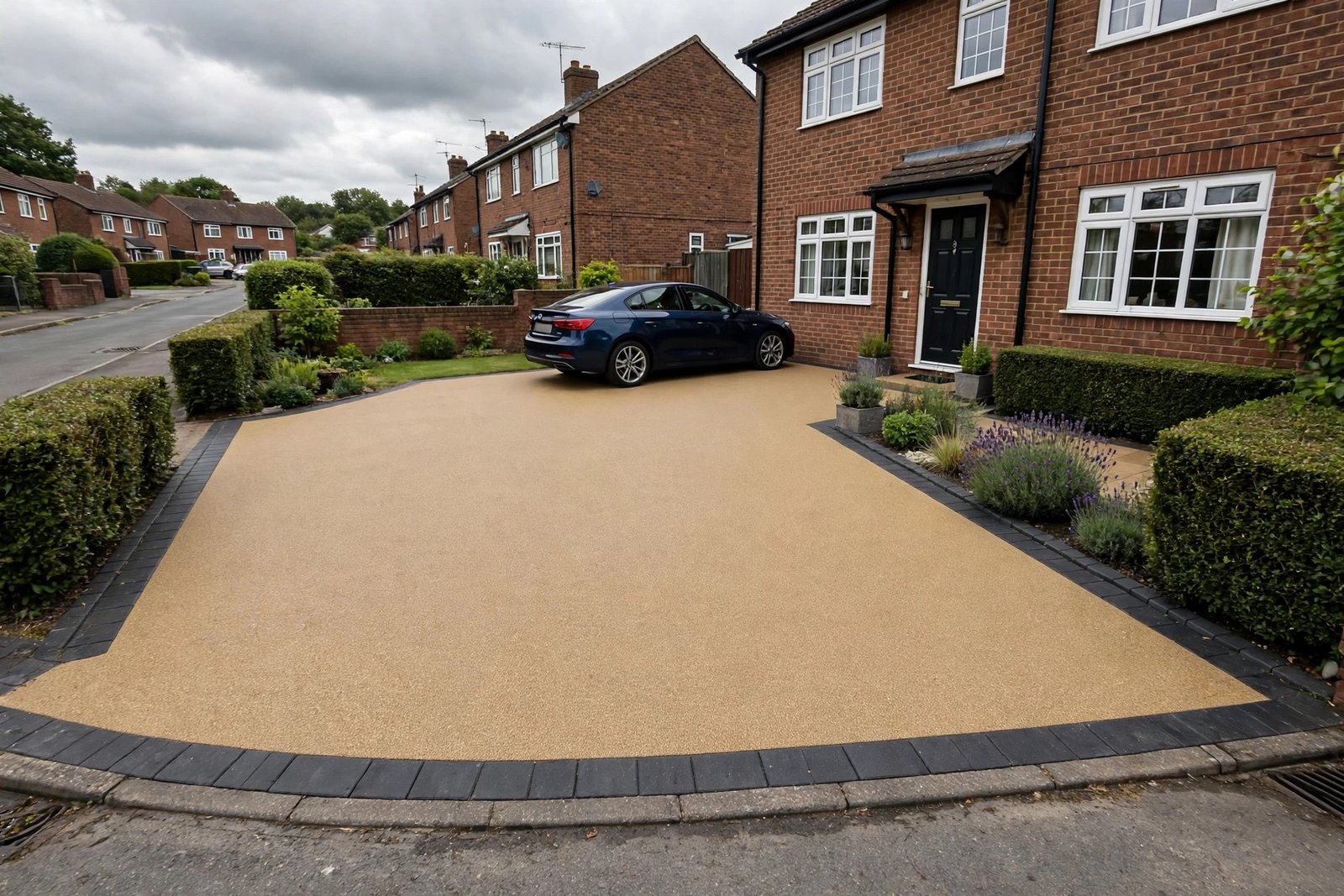
A resin bound driveway is aggregate — stone in a colour you choose — mixed with resin and trowelled out to an even depth, so the finished surface is smooth, with no loose stones underfoot and no joints to fill.
Its main strengths are the finish and the drainage. It looks clean and modern, it is comfortable to walk on and easy to sweep, and because the surface is permeable, rainwater drains through it rather than running off. That matters beyond puddles: a permeable front driveway normally sits within permitted development in England, where an impermeable one draining to the road may not. A driveway that falls toward the house may still need a channel drain, even with a permeable surface, so drainage still has to be planned, not assumed.
Upkeep is light: an occasional brush and a rinse, and that is most of it. There is no weeding between joints and nothing to re-sand.
Where resin is vulnerable is in the specification you cannot see once it has cured. Two things decide whether it lasts: the laid depth and the resin-to-aggregate ratio. Vehicle-trafficked resin needs greater depth than a footpath, and reducing depth to save money is a false economy that shows up as cracking. Resin also needs a firm edge to hold against — block, kerb or aluminium restraint — or the perimeter breaks away over time. And laying is weather-dependent: it has to be planned around rain and temperature, and left to cure before vehicles use it.
That is why our quotes state the laid depth and the resin ratio in writing, as we set out on our resin driveway cost page. If a quote does not state them, you cannot compare it with one that does.
Resin can often be laid over a sound existing tarmac or concrete surface, after cleaning, repair and priming. If the existing surface is breaking up or sinking, overlaying it simply transfers the problem to the new surface — in that case the old surface has to come out and a new compacted base built first. Nobody can tell which of those you need from a photograph, which is why we survey first.
Block paving: flexible and repairable, but hungry for upkeep
Block paving is the familiar one: individual blocks laid in a pattern on a sand bed, with joints filled with sand. It suits traditional houses, it comes in a wide range of colours and patterns, and it has one real advantage over the other two — if a block sinks or cracks, that block can be lifted and replaced without redoing the whole driveway.
Its weakness is the joints. Weeds grow through them, sand washes out of them, and blocks can sink or lift where vehicles turn or where water gets underneath. That means regular upkeep: weeding, re-sanding the joints, and lifting and re-laying any blocks that have settled. Left alone for a few years, a block-paved drive can look tired even though the blocks themselves are sound.
Block paving is only permeable if it is specified that way, with a permeable build-up underneath. A standard block-paved drive is not automatically a permeable one, so ask what the build-up is if drainage matters to you.
What to check in a quote: the depth and compaction of the sub-base, the edging that holds the blocks in, and whether the joints are sealed or just sanded. As with resin, the base is where a cheap quote usually gives itself away — a thin base settles, and settled blocks are the first thing you notice.
Tarmac: the cheapest to lay, the hardest to keep looking new
Tarmac is usually the quickest and least expensive surface to lay, and for a large, plain driveway that matters. A well-laid tarmac drive on a sound base is a practical, hard-wearing surface, and it can be laid over a large area in a day.
Its weaknesses are appearance and upkeep. Tarmac is not permeable, so rainwater runs off it and drainage has to be dealt with elsewhere. The surface softens in hot weather, which is when heavy vehicles and turning wheels can mark it, and the edges are prone to breaking away unless they are properly restrained. Over time it fades, and it needs periodic sealing and edge repairs to keep it looking its best.
That does not make tarmac a bad choice — for a large drive where budget matters most and looks matter least, it can be the sensible one. But if you are choosing it mainly because the quote is the lowest, check what has been left out: the base, the edging, and the drainage. A tarmac drive laid thin over a poor base will crack and sink just as surely as any other surface laid the same way.
Which lasts longest? The honest answer
On a proper base, laid to the right depth and looked after, all three can last many years. The difference is what "looked after" means, and what fails first:
- Resin bound: fails first at the edges or through cracking if it was laid too thin or with too little resin. Otherwise, very little upkeep.
- Block paving: rarely fails all at once — it fails block by block, through sinking, weeds and sand loss. Repairable, but it asks the most of you year to year.
- Tarmac: fails at the edges and through surface wear, and needs sealing to stay looking new. The lowest upkeep in the first year, the most visible ageing over time.
So if low upkeep and a clean finish matter most, resin bound has the edge. If you want a traditional look and the ability to replace a single block, block paving is the one. If budget and a large area matter most, tarmac is worth considering — with your eyes open about sealing and edges.
In every case, the question to ask is not "which surface lasts longest?" but "what is underneath this one, and what does the quote actually specify?" The base, the depth, the edging and the drainage decide the lifespan far more than the decorative stone on top.
What to check before you accept any driveway quote
Whatever surface you choose, ask for these in writing before you agree to anything:
- Whether the existing surface is being overlaid or excavated, and why.
- The depth of the base and, for resin, the laid depth and the resin-to-aggregate ratio.
- What edging or restraint is included, and how drainage is being handled.
- What the aftercare is, and when the surface can take vehicles.
That is the same list we use ourselves, and it is the list in our guide to what to ask before you accept a quote — written for artificial grass, but the principle is identical: the specification matters more than the surface on its own.
Not sure which suits your drive?
Every driveway is different — size, what is down there now, how it drains, and how many vehicles use it. Send us rough dimensions and a photo or two, and we will come out, look at it properly, and give you an honest view on which option suits it, with a free fixed written quote if you go ahead. No obligation, and no pressure either way.
We install resin bound driveways across Wigan, Standish and the North West, as well as artificial lawns, porcelain paving and bespoke fencing. Read the full guide on our resin driveway cost page.
Find out what your driveway would cost
Rough size and a couple of photos is all we need to get started. Call 07967 293173, email everlastinglawns@icloud.com, or get a free quote — free survey, fixed written price, no obligation. Our office is 85 School Lane, Standish, Wigan WN6 0TE.