Artificial grass for dogs: what pet owners should know
If you have a dog, your garden works harder than most. There is the daily run to the back door, the same worn path across the lawn, the digging spot, the muddy paws after rain — and in winter, a real lawn can turn into a mud patch in a matter of weeks. That is why so many dog owners in Wigan ask us about artificial grass.
It can be a very good fit for a dog household, but only if the right turf is chosen and it is laid properly. A lawn picked for looks alone, or laid on a poor base, will show the wear of a dog far sooner than one chosen with pets in mind. Here is what to think about before you decide.
Why dog owners choose it
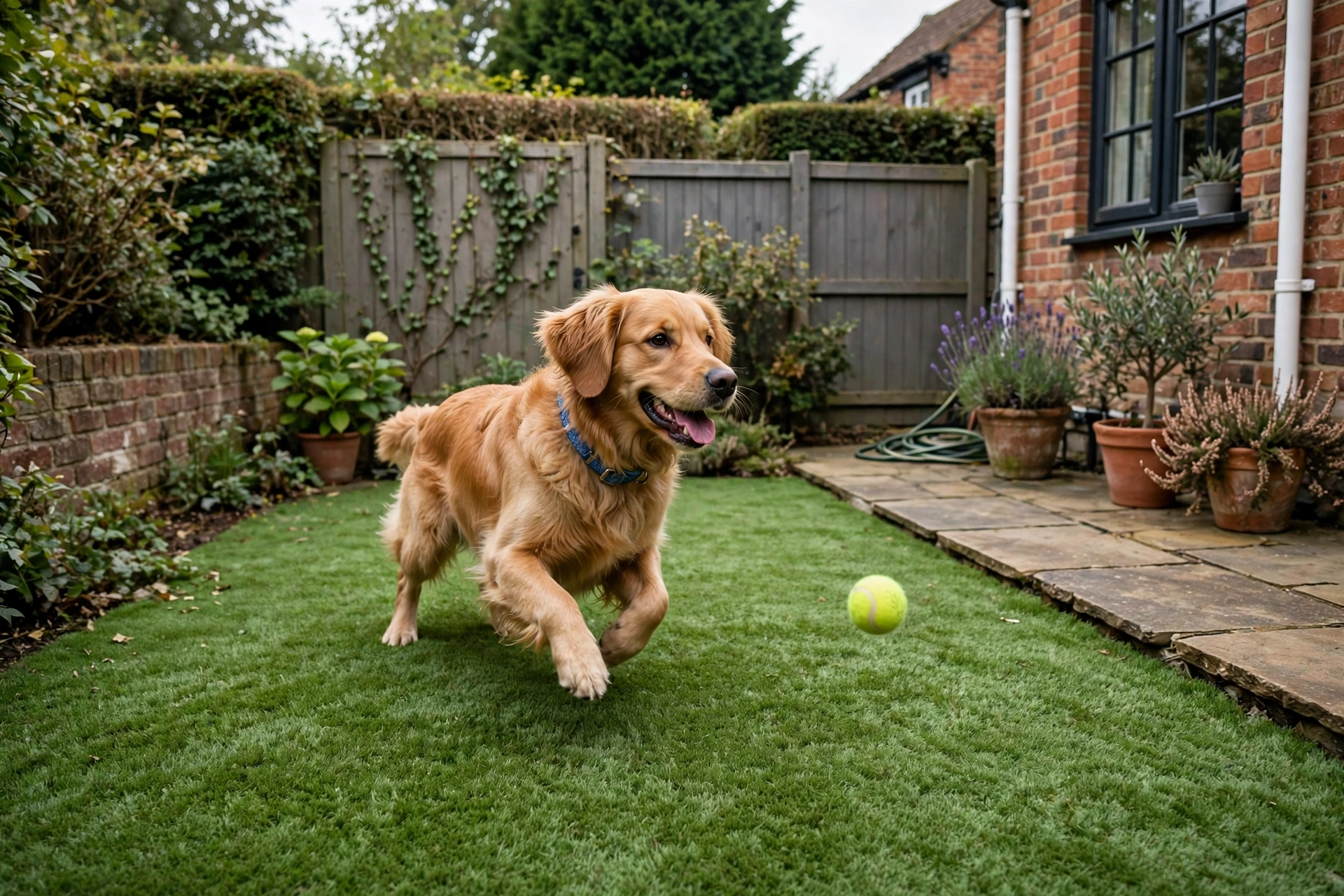
The main reason is simple: no mud. A dog that comes in from a wet real lawn brings the garden with it — on paws, on the floor, on the sofa. Artificial grass stays green and even through rain, so there is far less mud to clean up, and the garden still looks like a garden in February, not just in June.
It also means no bare patches where the dog always runs, no digging up the same corner, and no lawn to mow around a dog that wants to be out there while you work. That is the same low-maintenance appeal we covered in our comparison of artificial grass vs real grass — with a dog, the difference is just more obvious, more often.
Choose a hard-wearing turf
Not all artificial grass is the same, and a garden with a dog needs a tougher grade than a front lawn nobody walks on. Look for a dense, hard-wearing turf with fibres that spring back after being walked on, rather than a soft, fine turf chosen only for how it looks in a showroom.
This is one of the things to check in a quote, as we set out in our guide on what to ask before you accept a quote. Ask what grade of turf is being quoted, and whether it is the grade the installer would choose for a garden with a large or very active dog. A cheap turf can look fine when it is new and then flatten and go patchy much sooner under daily use.
Drainage matters more with a dog
Drainage is important for every artificial lawn, and more so when a dog uses it every day. Urine needs to drain away through the turf and the base underneath, not sit on the surface. That depends on the turf backing, the infill, and — most of all — the sub-base it is laid on, laid with falls so water runs off rather than pooling.
A lawn laid on a proper compacted, permeable sub-base will drain as it should. A lawn laid on a thin layer of grit, or on ground that was never properly prepared, will hold water and smell, and no amount of cleaning will fix that. The base is invisible once the job is done, which is exactly why it is the place where a cheap install saves its money — and why it is worth asking about, as we explain in our guide to how long artificial grass lasts.
Cleaning after a dog is simple — if you do it
Artificial grass does not clean itself. Solid mess should be picked up as you would from any lawn, and the area rinsed with water. Urine should be rinsed away rather than left to sit — a quick hose down is usually enough, and doing it regularly matters far more than any special product.
Leaves left sitting for weeks trap moisture and stain the pile, and a lawn that is never brushed will stay flat where the dog always runs. A brush every now and then lifts the pile back up and spreads the wear. That is the same care we recommend all year round in our guide to looking after artificial grass in winter — low maintenance, not no maintenance.
Do not use harsh chemicals or bleach on the lawn, and never light a barbecue or fire pit on it — heat and embers melt the fibres, and that damage cannot be brushed out.
What about wear?
Every lawn wears where it is used most — the path to the back door, the goalmouth in front of a small football net, the spot where the dog always runs. A dog will flatten the pile in those places first, and that is normal. Moving play equipment, planters and furniture around occasionally spreads the wear, and regular brushing helps the pile recover.
A large dog, used daily, will age a lawn faster than a decorative lawn in a quiet garden. That is worth knowing before you choose a turf grade, and it is one of the reasons a lawn for a dog household should be chosen for hard wear first and looks second — not the other way round.
A note on puppies and digging
Puppies dig, and a new lawn will not stop a determined puppy. Most dogs settle once the novelty wears off, especially if the edges are properly fixed so there is nothing loose to pull at. Without a fixed perimeter edge, the turf lifts and curls at the boundaries — one of the first things to fail on a cheap install. With the edges fixed and the seams taped and glued, there is far less for a dog to get hold of.
The honest answer
Artificial grass suits most dog households very well, provided three things are right: a hard-wearing turf chosen for pets, a proper permeable base with drainage, and edges and seams fixed as they should be. Get those right, and you get a garden that stays green, stays usable in winter, and stops bringing mud into the house. Get any of them wrong, and the dog will find the weakness sooner than you will.
If you are thinking about it, the best next step is a visit. We visit, measure properly and give you a written fixed quote free of charge — and we will tell you honestly whether artificial grass is the right choice for your garden and your dog, or whether something else would suit you better. Find us at everlastinglawns.co.uk.