How long does artificial grass last, and what shortens its life?
It is one of the first questions people ask us, and it is the one with the least satisfying short answer: it depends.
A well-installed artificial lawn, made from good-quality turf and laid properly, should last for many years of family use. A cheap lawn, or a good lawn laid badly, can start to look tired much sooner. The turf itself is rarely the whole story — what decides its life is the combination of the product, the installation underneath it, and how hard the garden is used.
So here is the honest answer we give our own enquirers, including what shortens a lawn's life and how to tell when it is genuinely wearing out, rather than just needing a brush.
What decides how long it lasts
Four things matter more than anything else, and three of them are decided on the day it is installed.
The turf. Good-quality turf uses UV-stabilised fibres that resist fading and flattening in sunlight. Cheaper turf can look fine when it is new and then fade, go patchy or lose its pile much sooner. Pile height, density and backing all vary, and a busy family garden wants something more hard-wearing than a low-traffic front lawn. This is one of the things to check in a quote, as we set out in our guide on what to ask before you accept a quote.
The base. A lawn laid on a proper compacted, permeable sub-base with drainage falls built in will stay level and drain properly for years. A lawn laid on a thin layer of grit, or on ground that was never properly prepared, will settle and ripple, and no amount of brushing will fix that. The base is invisible once the job is done, which is exactly why it is the place where a cheap install saves its money.
The edges and seams. Without a fixed perimeter edge, the turf lifts and curls at the boundaries — one of the first things to fail on a cheap install. Joins should be taped and glued, not pinned: pinned seams show as a visible line and open up over time. A lawn whose edges and seams are sound will look tidy for far longer than one whose edges are already lifting.
The infill. Sand infill brushed through the pile weights the lawn down and holds the fibres upright. Leaving it out saves the installer money and shortens the life of the lawn, because the pile flattens sooner and stays flat.
If those four are right, the lawn has a long life ahead of it. If any of them are wrong, the lawn will age fast, whatever the turf cost.
What shortens its life
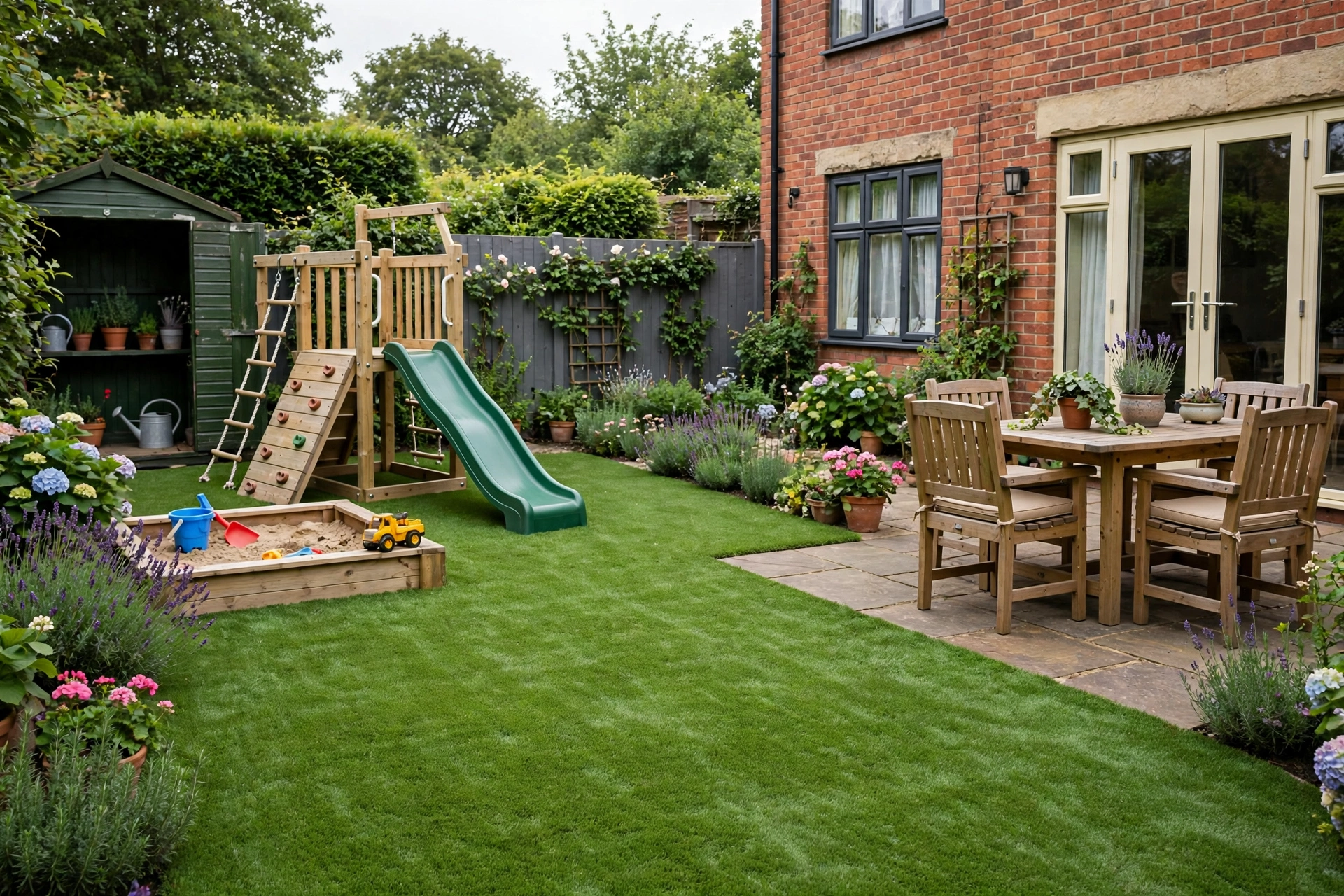
Heavy, repeated use in the same spot. Every lawn wears where it is used most — the path to the back door, the goalmouth in front of a small football net, the spot where the dog always runs. In a family garden that is normal, and it is the reason the pile in those places flattens first. Moving play equipment, planters and furniture around occasionally spreads the wear.
Pets. Dogs do not ruin artificial grass, but they do increase wear, and urine needs rinsing away rather than being left to sit. A lawn used daily by a large dog will age faster than a decorative lawn in a quiet garden, and that is worth knowing before you choose a turf grade.
Sun and heat. A south-facing garden gets more sun, and more UV, than a shaded one. Good UV-stabilised turf handles that well, but a lawn in full sun will always age a little faster than the same turf in shade. Heat is also why you should never light a barbecue, a fire pit or fireworks on the lawn — heat and embers melt the fibres, and that damage cannot be brushed out.
Neglect. Artificial grass is low maintenance, not no maintenance — as we covered in our guide to looking after artificial grass in winter. Leaves left sitting for weeks trap moisture and stain the pile. A lawn that is never brushed will stay flat in the places it is walked on. None of this is hard work, but a lawn that is never looked after at all will look older, sooner, than one that gets a brush every now and then.
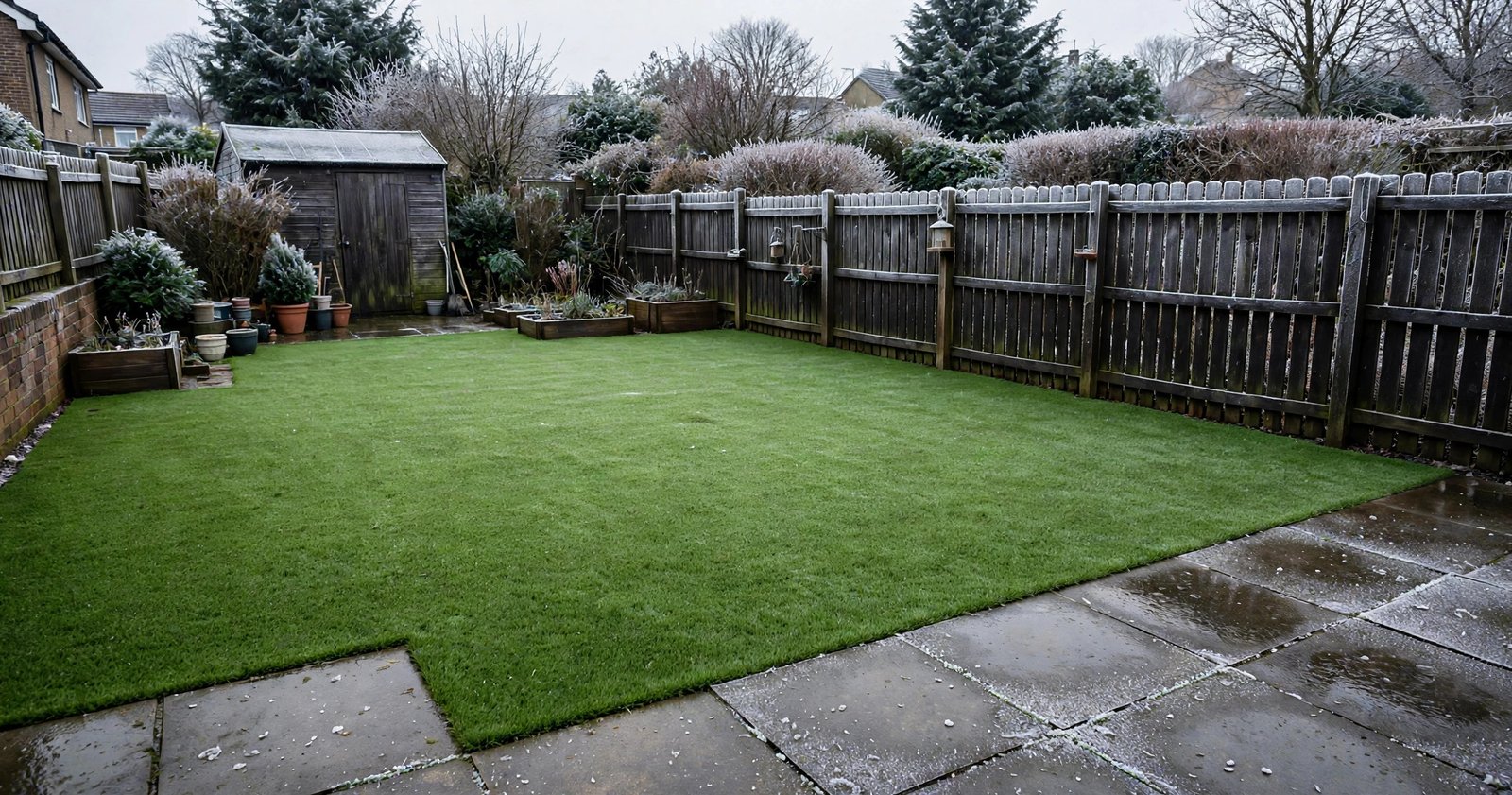
Frozen use. On a frosty morning the fibres are stiff and brittle. Heavy use while the lawn is frozen is one of the easiest ways to snap fibres, and snapped fibres do not recover. Wait for the thaw, as we set out in the winter guide, and the lawn will be back to normal.
The signs a lawn is wearing out
A lawn does not fail all at once. It shows its age gradually, and these are the signs to look for:
- Pile that stays flat. A brush lifts the pile back up on a healthy lawn. If the fibres stay flat and matted no matter how much you brush them, and you can see the backing showing through, the pile is worn.
- Seams and edges lifting. A seam that has opened, or an edge that has curled away from its fixing, will only get worse. Caught early it can often be repaired; left alone it becomes a trip hazard and lets water and dirt underneath.
- Standing water. On a well-installed lawn, laid on a proper compacted base with drainage falls, standing water is not normal. If water keeps pooling in the same place, something has changed underneath — a base that has settled, or drainage that is blocked.
- Fading or patchiness. Some fading over many years is normal, especially in full sun. Patchy fading, or one area that looks very different from the rest, usually points to a turf or installation problem rather than age alone.
- A lawn that looks tired despite care. If you are brushing it, clearing leaves and rinsing it, and it still looks flat and lifeless, the pile itself is likely at the end of its life.
One worn patch does not always mean the whole lawn needs replacing. A small damaged area can sometimes be patched, if the same turf is still available and the base underneath is sound. A lawn that is flat, faded and lifting in several places at once is usually past patching, and replacing it properly — base and all — will cost less in the long run than repeated repairs.
What extends its life
Most of it is simple, and it is the same care we recommend all year round:
- Brush the pile every now and then, especially in the places that get walked on most, to lift the fibres back up.
- Clear leaves regularly, so they do not trap moisture and stain the pile.
- Rinse after pet use and after muddy spells, and pick up solids as usual.
- Top up the sand infill if the pile starts to look thin and flat — it is the infill that holds the fibres upright.
- Move heavy planters, furniture and play equipment occasionally, so the pile does not flatten in one spot.
- Keep heat, fires and harsh chemicals off the lawn entirely.
A lawn that gets that small amount of care will outlast one that gets none, by a clear margin. It is the cheapest way to add years to it.
Repair or replace — how to decide
Ask three questions. Is the problem in one place, or all over? Is the base underneath still sound, or has it settled and started to hold water? And is the turf itself worn out, or just flat and dirty?
One lifting seam, one worn patch by the door, or a flat area where a planter sat all winter — those are repairs, and they are worth doing. A lawn that is flat everywhere, with lifting seams, curling edges and standing water, is telling you the installation has reached the end of its life, not just the turf. Replacing it is then the honest answer, and it is worth doing properly the second time — full excavation, compacted permeable base, fixed edging, taped and glued seams, sand infill — so the new lawn does not inherit the old one's problems.
If your lawn was installed by us and something does not look right, get in touch and we will come and look. Standing water, a seam lifting, an edge coming loose, or a patch that stays flat no matter how much you brush it are installation issues, not wear, and they are worth fixing properly.
The short version
A good artificial lawn, installed properly, lasts for many years. What shortens its life is almost always the installation, not the grass itself — a thin base, edges that were never fixed, seams that were pinned instead of taped and glued, or infill left out — plus heavy use in the same spot and a lack of even basic care.
That is why the specification matters more than the turf on its own. Compare the specification, not just the total, and ask what is in the quote, in writing, before you accept it. Read our guide on artificial grass vs real grass if you are still deciding between the two, and our guide on what to ask before you accept a quote before you choose an installer.
We install artificial lawns across Wigan, Standish and the North West, as well as porcelain paving, resin bound driveways and bespoke fencing. Read the full guide on our artificial grass cost page.
Find out what your garden would cost
Rough size and a couple of photos is all we need to get started. Call 07967 293173, email everlastinglawns@icloud.com, or get a free quote — free survey, fixed written price, no obligation. Our office is 85 School Lane, Standish, Wigan WN6 0TE.