Artificial grass for children: play areas that stay tidy
A garden with children in it gets used hard. There is football in the summer, a paddling pool, a trampoline, a bike, a ball that ends up in the flower bed, and a dozen trips in and out of the back door every day. A real lawn copes with some of that, and then it does not — worn patches by the door, a muddy strip where the goal is, and grass that turns to mud the moment it rains.
That is why many families in Wigan ask about artificial grass for a play area. Not because it looks like a perfect lawn in a photograph, but because it stays usable. The children can go out after rain without coming back covered in mud, the shoes stay cleaner, and the garden looks tidy at the end of the day rather than churned up.
Here is what to think about if you are choosing artificial grass with children in mind — what matters, what to check, and what to ask before you decide.
Soft ground underfoot, and what that really means
The first question most parents ask is about the surface itself: is it soft enough for children to play on? Artificial grass is a layer of fibres over a backing, laid on a prepared base, and how it feels underfoot depends on the grass and on what is underneath it.
A longer pile — the fibres standing up — feels softer and more forgiving than a very short, flat pile, and it is usually the better choice for a play area. But the base matters just as much. A properly prepared base, laid level and firm, gives a surface that is even to run on, with no dips or ridges to trip over. A base that has been rushed, or laid over an uneven surface, will show in the grass above it.
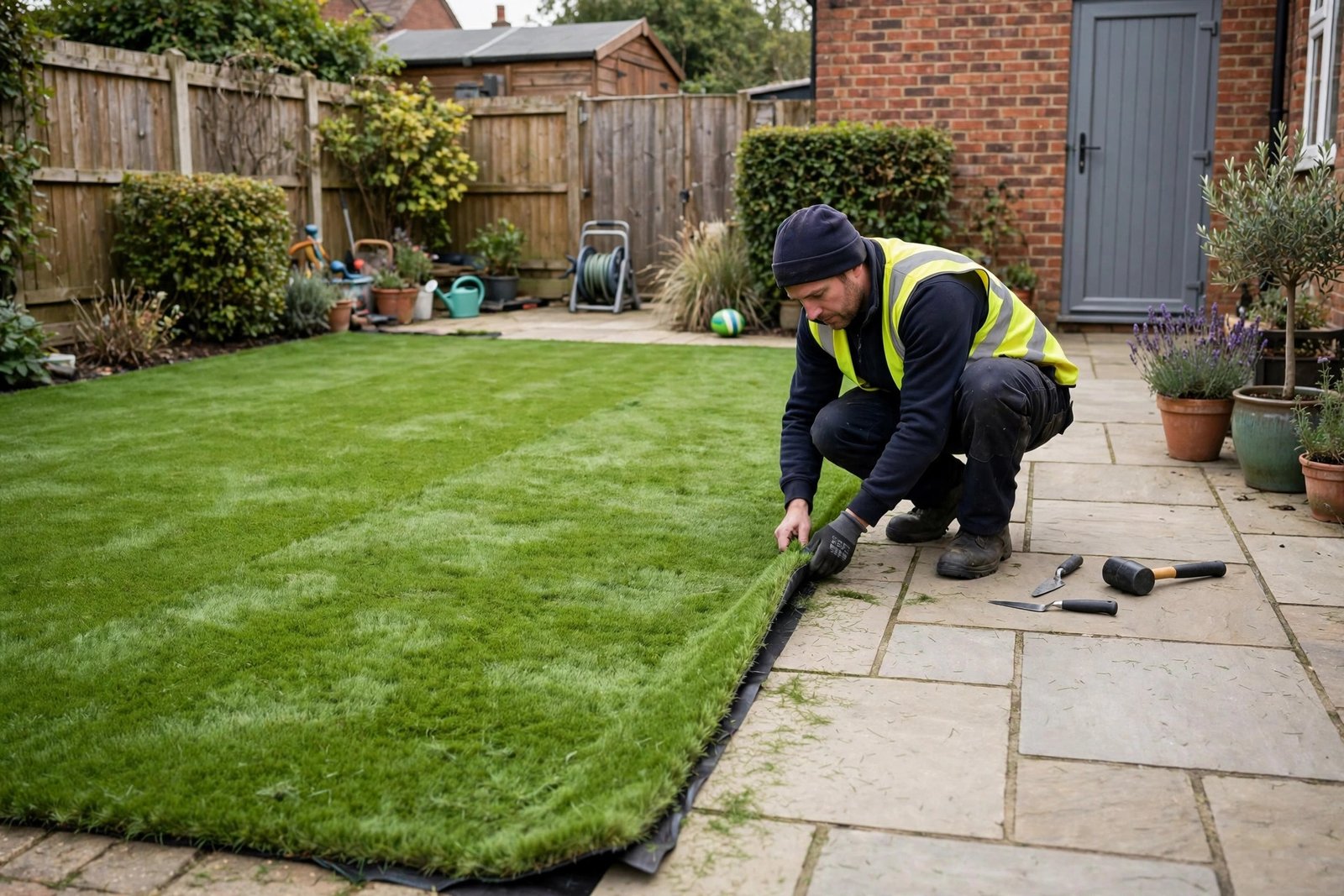
So when you look at a sample, do not just look at the colour. Press it, walk on it, and ask what goes underneath it. Ask how the base is prepared, and what happens where the grass meets a path, a patio or a fence. A play area needs to be level and firm at the edges as well as in the middle, because that is where children run, turn and fall.
If you are putting play equipment on the grass — a trampoline, a climbing frame, a swing — say so before the work starts. The area underneath and around equipment takes more wear than the rest of the lawn, and it is worth talking through how that area should be prepared, and whether anything extra is needed underneath it.
No mud, and what that changes day to day
The most obvious difference, day to day, is mud — or rather, the lack of it. On a real lawn, a wet week turns the busiest patches to mud, and that mud comes into the house on shoes, on knees and on the dog. On artificial grass, rain drains through the surface, and the children can go out after a shower without the garden turning into a mud bath.
That does not mean the garden looks after itself. Leaves, soil and general dirt still land on it, and they still need sweeping off, in the same way we described in our guide to looking after artificial grass in winter. A regular sweep keeps the surface clean and keeps the fibres standing up, which is what makes it look tidy and feel soft underfoot.
It also means the garden stays usable through the winter in a way a real lawn often does not. In Wigan, where wet weather is a fact of life for much of the year, that is the difference between a garden the children can use most days and a garden that is out of bounds from October to March.
Cleaning up after children — and after pets
Children are messy, and a play area needs to be easy to clean. Spilled drinks, dropped food, muddy footprints from a walk — most of it washes off artificial grass with water and a soft brush. That is the same simple care we covered in our guide to artificial grass for dogs, and it applies just as much to children: deal with a spill when it happens, rinse it through, and do not reach for harsh chemicals.
If you have both children and a dog, say so when you ask for a quote. The two uses overlap — the dog will use the same lawn the children play on — and it is worth making sure the grass and the base are chosen with both in mind, rather than finding out afterwards that one of them needs something different.
One thing to avoid is anything that could damage the surface. Hot objects should not be put directly on artificial grass — a barbecue, for example, belongs on a patio, not on the lawn. And anything spilled on the surface should be cleaned up promptly, rather than left to set. If you are unsure whether something is safe to use on the grass, ask the installer first, rather than trying it and hoping for the best.
What to check before you choose
A play area is not the place to choose grass on colour alone. Here is what to look for, and what to ask, before you decide:
- The pile and the feel. A longer pile is usually softer underfoot. Walk on the sample, in your shoes, and see how it feels. A grass that feels hard or flat in a showroom will feel the same in the garden.
- The base and the edges. Ask how the base is prepared, and how the edges are finished. A play area needs to be level, firm and safe at the edges, where children run and turn.
- Drainage. Ask how rain drains through the surface, and what happens in heavy rain. A play area that holds water after a shower is not much use, however good it looks in dry weather.
- Wear. Ask which areas wear first, and what happens when they do. The goalmouth, the area by the back door, and the ground under a swing will wear faster than the rest. It is better to know that before the work starts than to be surprised by it later.
- The sample in your garden. A sample on its own tells you very little. Ask to see it in your garden, next to the house, the fence and the patio, in the light your garden actually gets. The same grass can look quite different in shade, in sun, and next to red brick or grey render — which is the same point we made in our guide to how to choose a resin driveway colour and finish.
- What is included. Ask what the quote covers — the grass, the base, the edging, and the clearing away afterwards — and whether the quote is a fixed written quote after a survey. A quote that is clear about what is included is easier to compare with another quote than one that leaves the details vague.
A garden the children can actually use
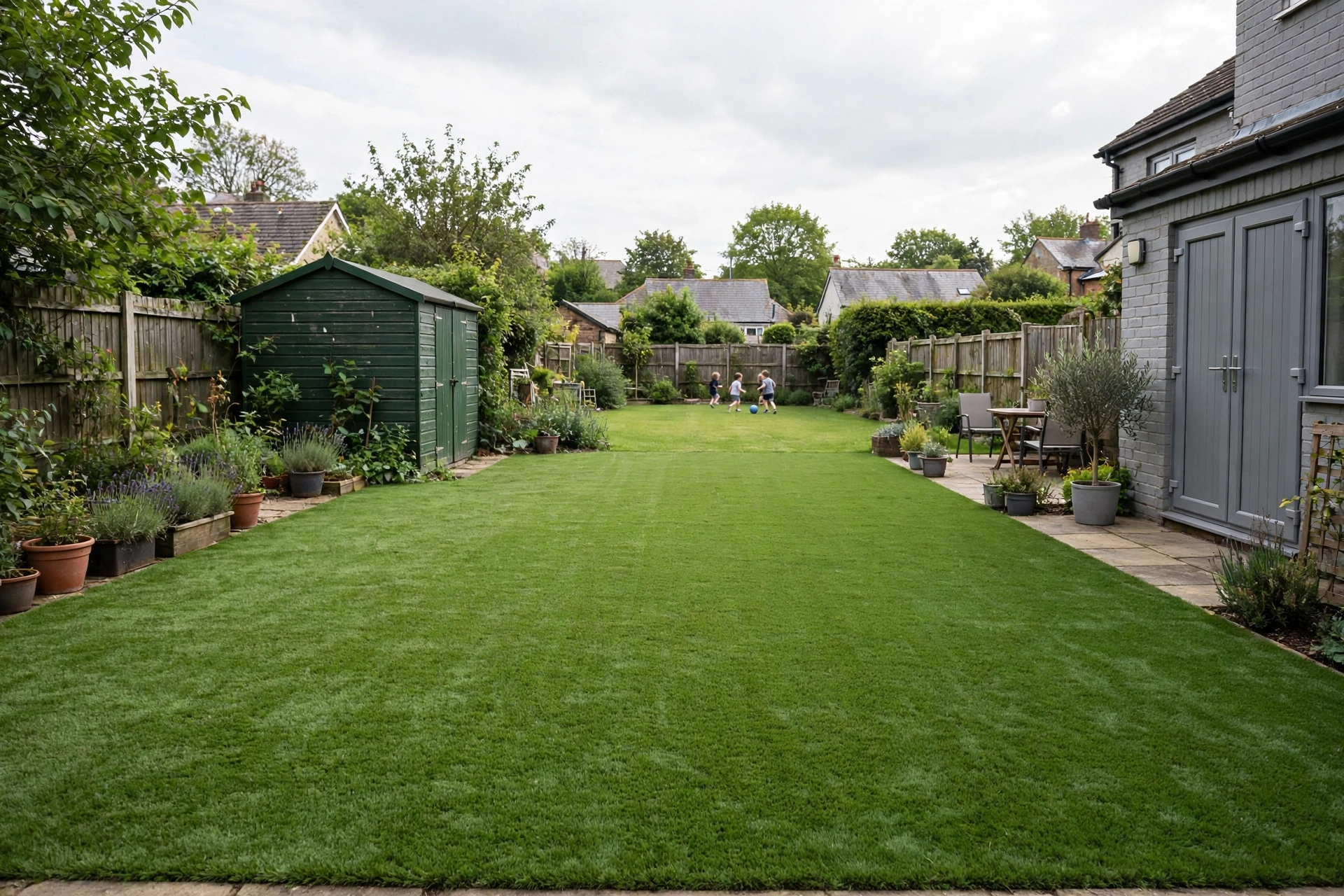
The point of artificial grass for children is not that it is perfect. It is that it is usable — in the rain, in the winter, after a game of football, and on a school morning when there is no time to clean up mud. A tidy garden that the children can play in most days of the year is worth more than a perfect lawn that is out of bounds for half of it.
If you are thinking about a play area in your garden, the next step is a survey. We will come and look at the garden, talk through how your children use it, and give you a free fixed written quote — no obligation, and no prices guessed over the phone. Find out more at everlastinglawns.co.uk.