What happens on artificial grass installation day?
If you are thinking about artificial grass, one of the first questions is usually: what will the day itself be like? How much mess will there be, what will the garden look like while the work is going on, and what should you expect when the team leaves?
Every garden is different, and every job is different — the ground underneath, the size of the garden, and what is there already all affect the work. But the steps are broadly the same on every installation, and knowing them in advance makes the day much easier.
Here is what happens, step by step.
Before the team arrives
By installation day, the survey and the quote are already done, and you will have agreed what is being laid, where, and what happens to the edges — where the lawn meets the patio, the fence, the path, or a flower bed. That matters, because the edges are where a lawn either looks finished or looks like it was laid in a hurry.
It is worth clearing the garden before the team arrives: move garden furniture, pots, children's toys and anything else that is in the way, and make sure there is a clear route for the team to bring materials in and take the old lawn away. If there is a side gate, make sure it is unlocked. And if you have pets, plan where they will be while the work is going on — the garden will be a building site for the day, and it is no place for a dog.
Clearing the old lawn
The first job is to remove what is there already. The old lawn — grass, weeds, and the top layer of soil underneath it — is lifted and taken away. This is the messiest part of the day, and it is also the part that cannot be skipped.
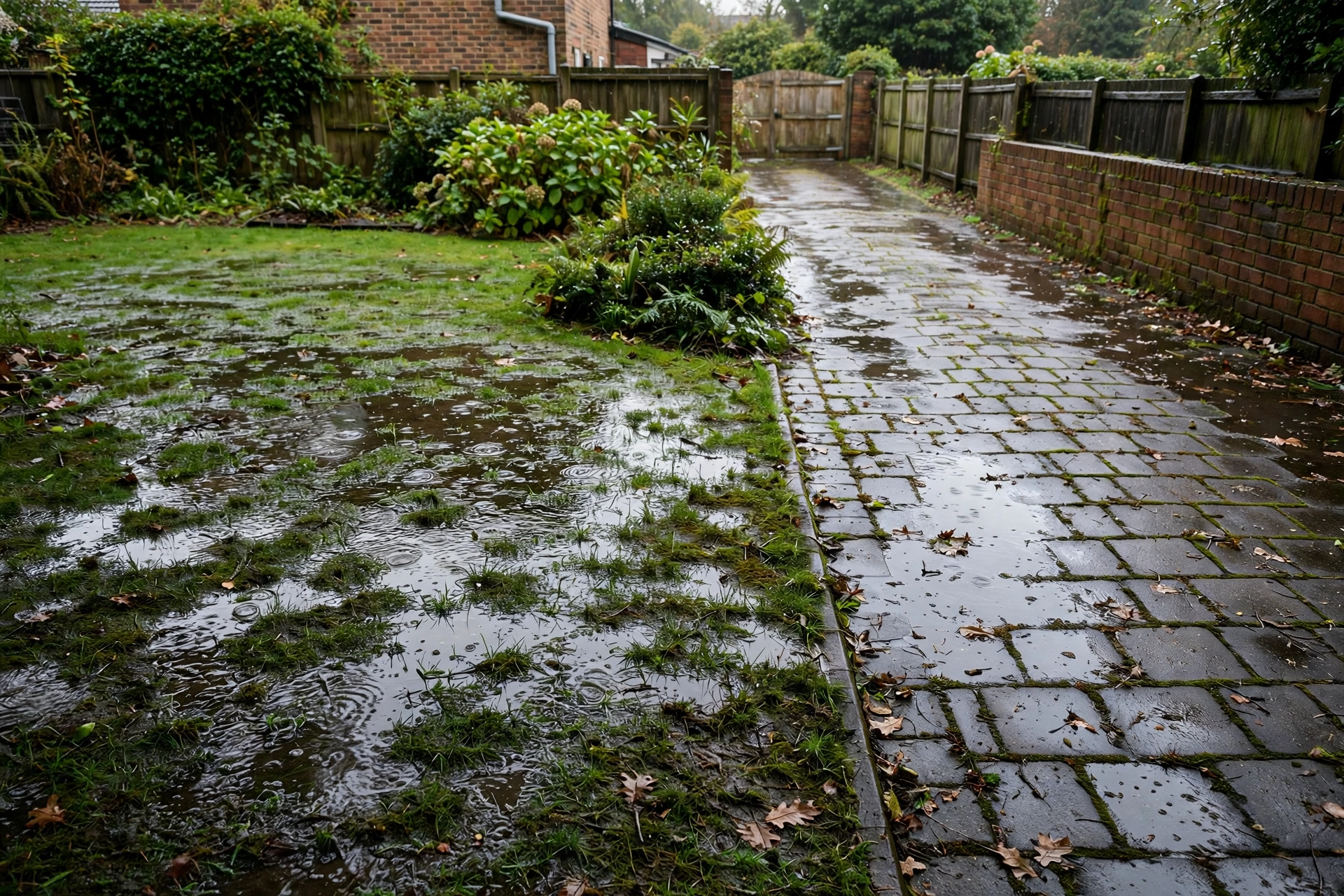
It is tempting to think the old lawn can just be covered over, but it cannot. A new lawn laid over an old one will be uneven, it will hold water, and the old grass and weeds will grow through. That is the same point we made in our guide to a soggy garden: a new surface over a poor base will be a problem again within weeks, so the base has to be dealt with first.
Once the old lawn is out, the ground underneath is checked. If there are dips, roots, or soft spots, they are dealt with now — not after the turf is down.
The base: the work you will never see
The base is the most important part of the job, and it is the part you will never see once the lawn is laid. It is also the part that decides whether the lawn stays level, drains properly, and lasts.
A layer of stone is laid and compacted, to give the lawn a firm, level foundation that water can drain through. The base is shaped with a slight fall, so water runs away from the house rather than towards it, and the levels are checked carefully — a base that is not level will show in the finished lawn, and a base that does not drain will hold water under the turf.
This is the work that takes the most care, and the work that is hardest to see in a finished lawn. It is also the work that separates a proper installation from a quick one. A lawn that looks the same on the day can look very different a year later, depending on what is underneath it — which is why we made the same point in our guide to how long artificial grass lasts: the hidden work underneath decides how long the visible work lasts.
A weed membrane is usually laid over the base, to help stop weeds coming through. It is not a guarantee — nothing is, where weeds are concerned — but it is one more layer between the soil and the turf.
Laying the turf
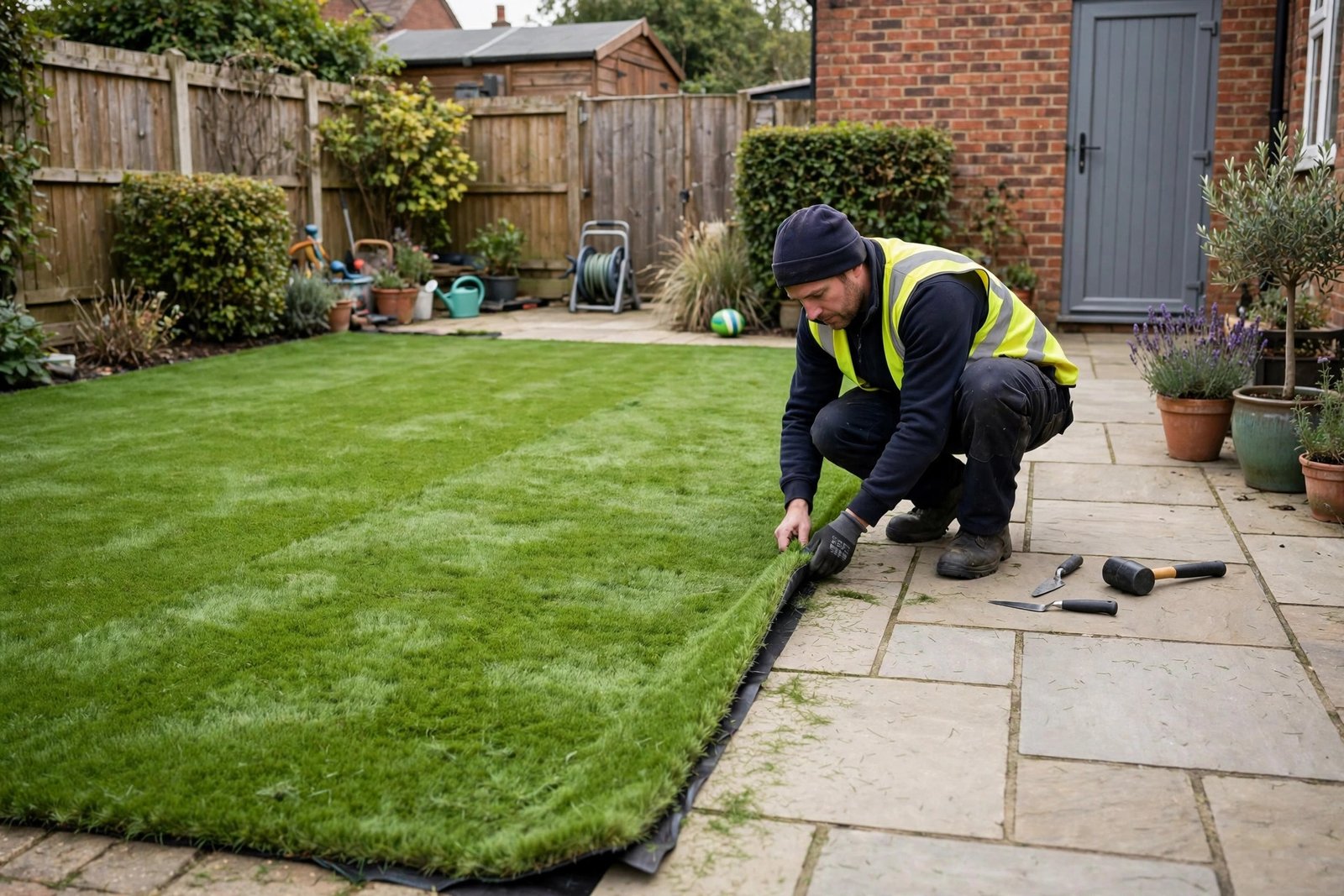
Only when the base is ready does the turf itself come out. The rolls are laid out, in the direction that looks best from the house — the direction you will look at it from most often — and left to settle before they are cut.
Then the turf is cut to fit the garden: around the patio, along the fence, around trees and beds. This is careful work. A good cut follows the edge of the garden exactly, with no gaps and no overlaps, and the joins between rolls — where two pieces of turf meet — are made so they are hard to spot. A join that is done well should be invisible from a few steps away. A join that is done badly will show every time you look at the lawn.
The edges are then fixed in place, so the turf cannot move or lift. How the edge is finished depends on the garden — it may be pinned, or held by the edging around the lawn — but the test is the same: the edge should be firm, neat, and flush with the surface next to it.
Infill and brushing
Once the turf is laid and fixed, infill is brushed into it. Infill is a fine material, usually sand, that sits down among the fibres of the turf. It does two jobs: it helps hold the turf in place, and it helps the fibres stand up, so the lawn looks like grass rather than a flat mat.
The lawn is then brushed, against the direction of the fibres, to lift them and to work the infill down evenly. This is the step that makes the biggest visible difference at the end of the day — a lawn that has been brushed properly looks fuller and more natural than one that has just been unrolled.
If you have dogs, this is worth knowing about in advance: infill and brushing are part of why a lawn stays in good shape with pets using it, as we covered in our guide to artificial grass for dogs. A lawn that is properly laid and properly filled will cope with pets far better than one that is not.
The tidy-up, and what to check before the team leaves
A good installation ends with a tidy garden. The old lawn and the waste are taken away, the path and the patio are swept, and the garden is left as it should be — with a new lawn, not a building site.
Before the team leaves, walk the garden with them. Check the things that matter:
- Are the edges neat, with no gaps and no turf lifting?
- Are the joins hard to spot, and do the fibres run in the same direction across them?
- Is the lawn level, with no dips or humps underfoot?
- Does the water have somewhere to go — away from the house, not towards it?
- Is the garden tidy, with the waste taken away?
If anything does not look right, say so while the team is still there. It is far easier to fix a join or an edge on the day than to come back to it later.
Looking after it afterwards
An artificial lawn is low-maintenance, not no-maintenance. Leaves should be cleared, especially in autumn — a layer of wet leaves left on the lawn will make it slippery and can stain it. Pet mess should be picked up and the area rinsed, as we covered in our winter-care guide to looking after artificial grass in winter. And every so often, a brush across the fibres will lift them back up, particularly where the garden gets the most use.
That is most of what it needs. No mowing, no watering, no feeding — and a garden that looks the same in January as it does in July.
The honest answer
Installation day is a day of work, and the garden will look worse before it looks better — the old lawn comes out, the base goes in, and for a while the garden is a building site. But by the end of the day, you should have a level, well-finished lawn, with neat edges, joins you have to look for to find, and a garden that is tidy again.
If you are thinking about it, the best next step is a visit. We visit, look at the garden properly, and give you a free fixed written quote after a site survey — and we will tell you honestly what the garden needs, including whether the base and the drainage need proper work first. Find us at everlastinglawns.co.uk.