Fencing for privacy: what to ask before you choose
Most people choose a fence for privacy for a simple reason: they want to use their garden without feeling overlooked. A garden that feels private gets used more — for sitting out, for children playing, for eating outside — and a garden that feels overlooked gets used less, however nice the lawn or the patio is. The fence is what makes the difference.
But privacy is not just about choosing the tallest fence you can find. A fence that is too tall for the garden can shade it, block the light, and make a small garden feel smaller. A fence with the wrong style can look solid from one side and gappy from the other. And a fence put up without checking where the boundary is can cause a disagreement with a neighbour that lasts far longer than the fence itself. This guide covers what to ask before you choose, so the fence suits the garden, the house and the people who live there.
It builds on our guide to fencing in Wigan: what makes a fence last, which looks at materials, posts and what keeps a fence standing.
If you are thinking about the garden as a whole, our front garden ideas show how fencing works alongside grass, paving and planting.
Start with what you actually want to block
Privacy means different things in different gardens, and the first question is what you are trying to block, and from where. A garden overlooked by a neighbour's upstairs window needs something different from a garden that faces a footpath, and both are different again from a garden that simply feels open to the street.
Stand in the garden and look at it as a neighbour would. Where can someone see in from? Is it one spot — a window, a gap at the side, the end of the garden — or is it the whole garden? Is the problem at ground level, or from above? A fence that blocks the view from the pavement may do nothing about the view from a first-floor window, and a fence that solves the window may be far taller than the garden needs at ground level.
Think about when the garden is used, too. A garden used mainly in the evening, when the neighbours are also at home, needs privacy at that time of day. A garden used by children in the afternoon needs it then. And think about what the fence will block besides the view — a solid fence also blocks wind and sound, which can be a benefit, but it can also block light, which in a north-facing garden matters a great deal. The right fence is the one that blocks the view you mind, and keeps the light and the air you want.
Height: taller is not always better
Height is the first thing people ask about, and it is the one that most needs a conversation rather than a guess. A taller fence gives more privacy, but it also casts a longer shadow, and in a small garden that shadow can fall across the lawn or the patio for much of the day. A fence that makes the garden private but dark has solved one problem and created another.
Ask the installer what height would work for your garden, rather than choosing a height first and fitting the garden around it. They will look at the slope of the ground, the position of the house, and where the light comes from, and they will be able to say what difference a height will make in practice. A garden on a slope, for example, may need a different approach at one end from the other, because the ground itself changes the height of the fence from the neighbour's side.
It is also worth asking, before anything is ordered, whether there is anything about the boundary or the area that affects what can be put up — a shared boundary, a fence that already belongs to one side, or a front garden where the rules are different from a back garden. Do not assume, and do not guess at a figure. Ask the installer, and if they say it needs checking, check it before the work starts. Sorting that out afterwards is far harder than sorting it out first.
Style: solid, slatted, or something in between?
A privacy fence does not have to be a solid wall of timber. The style matters — for how much it blocks, for how it looks, and for how it handles wind and light.
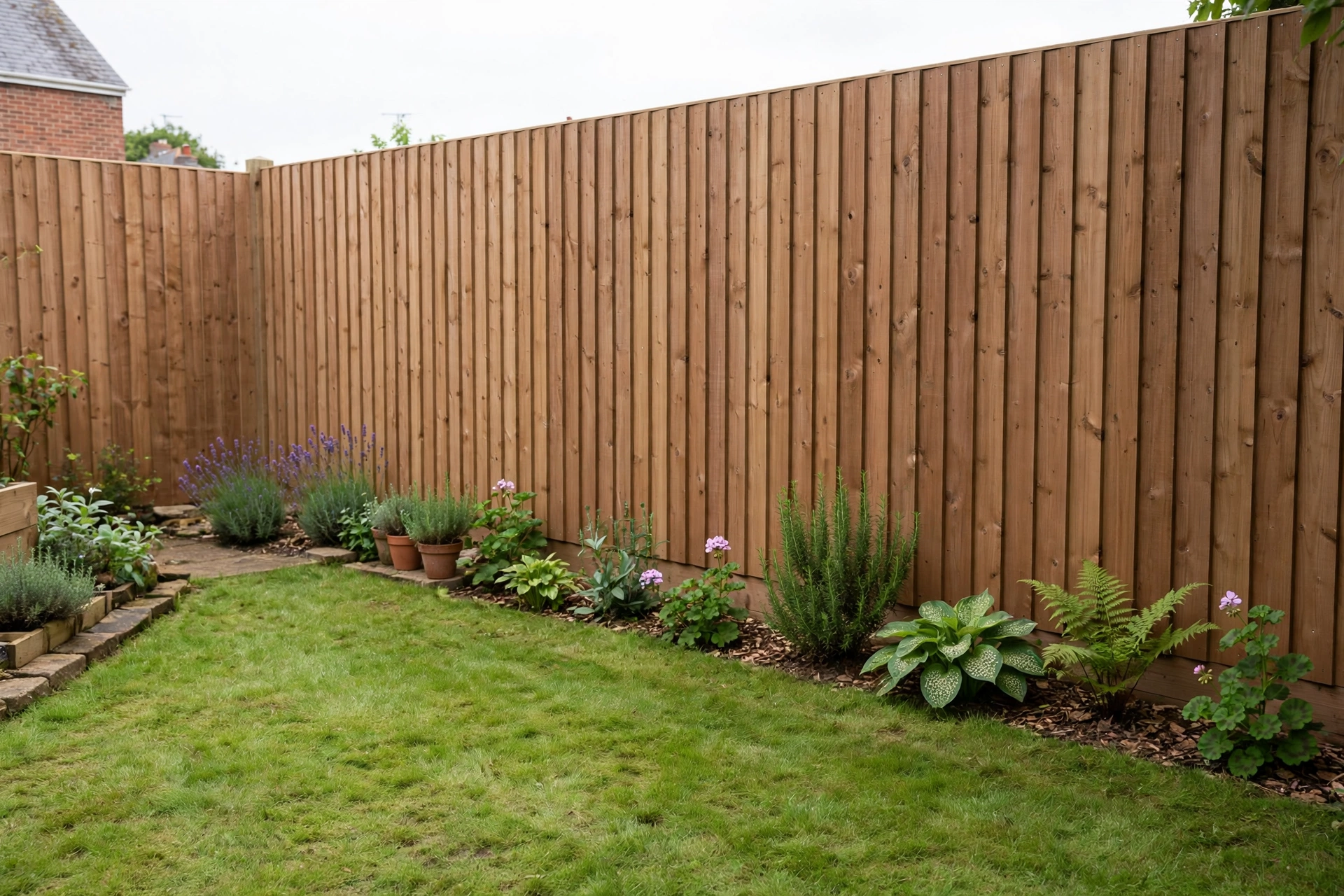
A close-board fence, with boards fitted tightly together, gives the most complete screen. It is the straightforward choice where the aim is simply to block the view, and it looks tidy from both sides if it is finished properly. It also catches the most wind, so it needs solid posts and good fixing — which is why the question of what makes a fence last, covered in our earlier guide, matters just as much for a privacy fence as for any other.
A slatted fence, with gaps between the boards, gives partial privacy. It blocks the direct view while letting light and air through, and it can feel lighter in a small garden. The trade-off is that it does not block the view completely — from an angle, or from above, someone can still see through the gaps. That may be fine where the aim is to soften the view rather than to block it entirely, and it may not be enough where the garden is closely overlooked.
There are styles in between, too — boards that overlap so there is no straight line through, but with a small gap that lets air move, or a fence with a solid lower part and a lighter top. The right choice depends on the garden: how overlooked it is, how much light it gets, and how it will be used. Ask to see examples of each style in a real garden, rather than choosing from a picture alone. A fence looks very different standing in a garden from how it looks in a catalogue.
Gaps, gates and the places a fence does not cover
A fence only gives privacy where it actually runs. The gaps matter as much as the fence itself — the side passage, the gate, the place where the fence meets the house, and the end of the garden. A tall, solid fence with an open side gate gives no privacy at all from that side, and a fence that stops short of the house leaves a line of sight straight into the garden.
Walk the boundary before you choose, and look for the gaps. Where does the fence need to start and finish? Is there a gate, and does it need to match the fence for height and style, or will it be the one place anyone can see through? Does the fence meet the house neatly, or is there a gap where the two join? And what about the far end — does the fence need to run the full length, or is part of the boundary a hedge or a wall that already does the job?
Gates deserve a thought of their own. A gate that is lower than the fence, or made of open slats while the fence is solid, will be the weak point in the privacy of the whole garden. It also needs to be practical — wide enough for what goes through it, easy to open and close, and able to be locked if that matters. Ask about the gate at the same time as the fence, not as an afterthought, so the two are planned together.
Boundaries and neighbours: ask before you build
Few things cause more trouble between neighbours than a fence, and almost all of that trouble comes from not asking first. Before any work starts, it is worth knowing whose boundary it is, where the boundary actually runs, and what is already there.
If there is an existing fence, ask who owns it and who is responsible for it. If the boundary is shared, talk to the neighbour before the work is planned, not after the materials have arrived. A neighbour who has been told what is planned, and has had a chance to say what they think, is far more likely to be happy with the result than one who first learns about it when the posts go in. That conversation costs nothing, and it can save a great deal.
It is also worth thinking about how the fence will look from the neighbour's side. A fence that looks finished on your side and rough on theirs is a needless source of friction. A fence finished neatly on both sides — or with the neater side facing the neighbour where that is the custom — is a small kindness that costs little and is remembered.
If you are unsure where the boundary is, or whether a fence can go where you want it, ask the installer. They will have seen this before, and they will know what needs to be checked and who to ask. Do not guess, and do not build first and ask later.
Light, wind and the rest of the garden
A privacy fence changes more than the view. It changes the wind, the light and the way the garden feels, and those changes are worth thinking about before you choose.
A solid fence shelters the garden from the wind, which can be a benefit on an exposed site — plants do better, and sitting out is more pleasant. But it also creates shade, and in a garden that already gets little sun, a tall solid fence can make the shadier parts of the garden darker still. Think about where the sun is through the day, and where the fence's shadow will fall. A fence on the south side of a garden casts a very different shadow from a fence on the north side.
It also changes how the garden is used. A fence that encloses a small garden completely can make it feel smaller, while a fence that leaves a view out — over a hedge, or towards the end of the garden — can make the same space feel larger. If the garden is small, that feeling matters. Talk through it with the installer, and look at the garden together, rather than choosing a fence from a list.
And think about what goes with the fence. A fence on its own is a boundary; a fence with planting in front of it, or with a lawn and a patio that suit it, is part of a garden. Our front garden ideas guide shows how fencing, grass and paving work together, and the same thinking applies at the back — the fence should suit the garden it is in, not just the view it blocks.
What to ask the installer
Before you agree to anything, it is worth asking a few straightforward questions, and listening carefully to the answers:
- What height and style would you recommend for this garden, and why?
- What will it do to the light in the garden, and to the wind?
- Where exactly will the fence run, and what happens at the gates, the house and the ends?
- Whose boundary is it, and does anything need checking before work starts?
- What will the fence look like from the neighbour's side?
- What posts and fixing will be used, and what keeps the fence standing in a strong wind?
- What happens if a panel or a post needs replacing later — can it be done without taking the whole fence down?
The answers to those questions will tell you a great deal about the installer as well as the fence. A good installer will want to see the garden, will ask about how it is used, and will talk through the trade-offs rather than simply quoting for the tallest fence available. If the answers are vague, or if the questions are brushed aside, that is worth noticing.
A privacy fence is not a small purchase, and it will be part of the garden for a long time. It is worth choosing it slowly, asking the questions first, and making sure it suits the garden, the light and the neighbours — not just the view it blocks.
If you are thinking about fencing for privacy, or about a garden that feels more private and easier to use, the next step is a survey. We will come and look at the garden, talk through what would suit it, and give you a free fixed written quote — no obligation, and no prices guessed over the phone. Find out more at everlastinglawns.co.uk.